BLADE





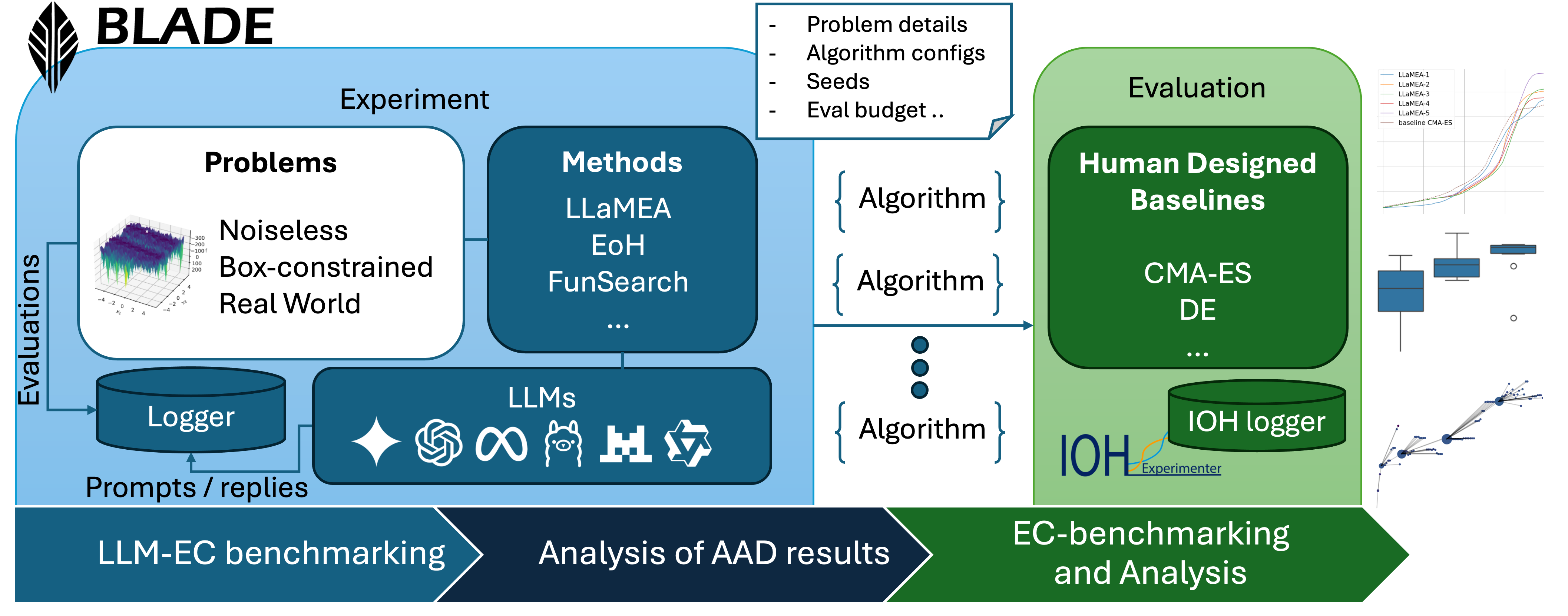
BLADE is a Python framework for benchmarking the Llm Assisted Design and Evolution of algorithms. BLADE (Benchmark suite for LLM-driven Automated Design and Evolution) provides a standardized benchmark suite for evaluating automatic algorithm design algorithms, particularly those generating metaheuristics by large language models (LLMs). It focuses on heuristic optimization and integrates a diverse set of problems and methods, facilitating fair and comprehensive benchmarking.
Documentation Guide
Start here for conceptual usage: Introduction and Quick Start.
For benchmark catalog and taxonomy: Benchmarks.
For API reference by feature area: BLADE API.
For interactive monitoring: Webapp.
Comprehensive Benchmark Suite: Covers various classes of black-box optimization problems.
LLM-Driven Algorithm Design: Supports algorithm evolution and design using large language models.
Built-In Baselines: Includes state-of-the-art metaheuristics for comparison and LLM-driven AAD algorithms.
Automatic Logging & Visualization: Integrated with IOHprofiler for performance tracking.
Included Benchmark Function Sets
BLADE incorporates several benchmark function sets to provide a comprehensive evaluation environment:
Name |
Short Description |
Number of Functions |
Multiple Instances |
|---|---|---|---|
BBOB (Black-Box Optimization Benchmarking) |
A suite of 24 noiseless functions designed for benchmarking continuous optimization algorithms. Reference |
24 |
Yes |
SBOX-COST |
A set of 24 boundary-constrained functions focusing on strict box-constraint optimization scenarios. Reference |
24 |
Yes |
MA-BBOB (Many-Affine BBOB) |
An extension of the BBOB suite, generating functions through affine combinations and shifts. Reference |
Generator-Based |
Yes |
GECCO MA-BBOB Competition Instances |
A collection of 1,000 pre-defined instances from the GECCO MA-BBOB competition, evaluating algorithm performance on diverse affine-combined functions. Reference |
1,000 |
Yes |
HLP (High-Level Properties) |
Generated benchmarks guided by high-level property combinations (e.g., separable, multimodality). |
Generator-Based |
Yes |
In addition, several real-world applications are included.
Real World Benchmarks
Name |
Description |
|---|---|
Analysis |
|
Auto-Correlation 1 |
Minimise |
Auto-Correlation 2 |
Maximise |
Auto-Correlation 3 |
Minimise |
AutoML |
|
AutoML Pipelines |
Generate and evaluate machine learning pipelines using scikit-learn. |
Combinatorics |
|
Erdős Minimum-Overlap Problem |
Minimise the suprenum overlap integral between complementary measurable functions. |
Euclidean Steiner Tree Problem |
Minimise |
Graph Colouring Problem |
Minimise the number of colours needed to colour graph nodes so adjacent nodes never share a colour. |
Fourier |
|
Fourier Uncertainty Inequality |
Minimise uncertainty bound for functions of form |
Geometry |
|
Heilbronn (Unit Triangle) |
Maximise the area of the smallest triangle formed by 11 points in a unit-area triangle. |
Heilbronn (Unit Convex Region) |
Maximise the area of the smallest triangle formed by 13-14 points in a unit-area convex region. |
Kissing Number (11D) |
Maximise number of integer vectors satisfying high-dimensional kissing constraints. |
Min/Max Distance Ratio |
Minimise squared ratio of maximum to minimum pairwise distances (2D/3D variants). |
Spherical Code |
Maximise the minimum pairwise angle among 30 points on a unit sphere. |
Kernel Tuner |
|
Kernel Tuning Benchmark |
Evaluate metaheuristics for hardware kernel optimisation under constraints. |
Logistics |
|
Travelling Salesman Problem |
Minimise total tour distance visiting each 2D point exactly once. |
Vehicle Routing Problem |
Minimise total travel distance for capacitated vehicles serving weighted customers. |
Matrix Multiplication via Tensor Decomposition |
|
Tensor CP Factorisation |
Find smallest CP rank enabling exact matrix multiplication under quantised factors. |
Number Theory |
|
Sums vs Differences |
Maximise |
Packing |
|
Circle Packing |
Maximise total packed circle area inside a circular container without overlap. |
Hexagonal Packing |
Minimise area of smallest enclosing hexagon containing disjoint regular hexagons. |
Rectangle Packing |
Pack disjoint circles inside a fixed-perimeter rectangle under containment constraints. |
Unit Square Packing |
Pack disjoint circles inside a unit square while satisfying non-overlap constraints. |
These benchmarks are provided with ready-to-run instances in
run_benchmarks/, while reusable benchmark definitions are organized under
iohblade/benchmarks by domain.
Included Search Methods
The suite contains the state-of-the-art LLM-assisted search algorithms:
Algorithm |
Description |
Link |
|---|---|---|
LLaMEA |
Large Language Model Evolutionary Algorithm |
|
EoH |
Evolution of Heuristics |
|
FunSearch |
Google’s GA-like algorithm |
|
ReEvo |
Large Language Models as Hyper-Heuristics with Reflective Evolution |
|
LLM-Driven Heuristics Neighbourhood Search |
LLM-Driven Neighborhood Search for Efficient Heuristic Design |
|
Monte Carlo Tree Search |
Monte Carlo Tree Search for Comprehensive Exploration in LLM-Based Automatic Heuristic Design |
Note
FunSearch is currently not yet integrated.
Supported LLM APIs
BLADE supports integration with various LLM APIs to facilitate automated design of algorithms:
LLM Provider |
Description |
Integration Notes |
|---|---|---|
Gemini |
Google’s multimodal LLM designed to process text, images, audio, and more. Reference |
Accessible via the Gemini API, compatible with OpenAI libraries. Reference |
OpenAI |
Developer of GPT series models, including GPT-4, widely used for natural language understanding and generation. Reference |
Integration through OpenAI’s REST API and client libraries. |
Ollama |
A platform offering access to various LLMs, enabling local and cloud-based model deployment. Reference |
Integration details can be found in their official documentation. |
Claude |
Anthropic’s Claude models for safe and capable language generation. Reference |
Accessed via the Anthropic API. |
DeepSeek |
Developer of the DeepSeek family of models for code and chat. Reference |
Access via OpenAI compatible API at |
Evaluating against Human Designed Baselines
An important part of BLADE is the final evaluation of generated algorithms against state-of-the-art human-designed algorithms. In the iohblade.baselines part of the package, several well-known SOTA black-box optimizers are implemented to compare against, including but not limited to CMA-ES and DE variants.
For the final validation, BLADE uses IOHprofiler, providing detailed tracking and visualization of performance metrics.
🤖 Contributing
Contributions to BLADE are welcome! Here are a few ways you can help:
Report Bugs: Use GitHub Issues to report bugs.
Feature Requests: Suggest new features or improvements.
Pull Requests: Submit PRs for bug fixes or feature additions.
Please refer to CONTRIBUTING.md for more details on contributing guidelines.
License
Distributed under the MIT License.
See LICENSE for more information.
Cite us
If you use BLADE in your research, please consider citing the associated paper:
TBA